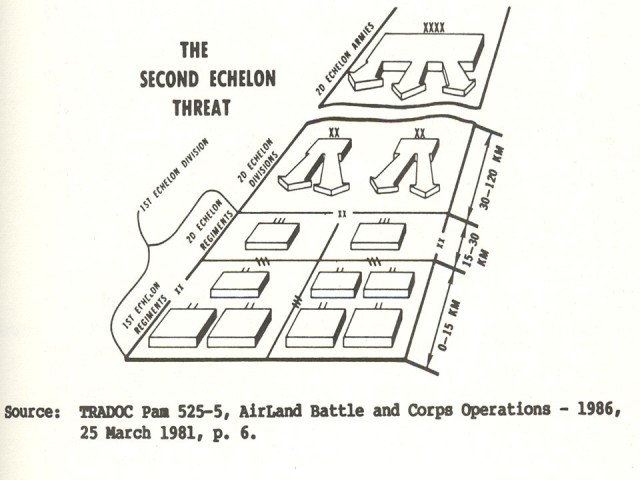
The Soviet Second Echelon Threat from U.S. Army Training and Doctrine Command Pamphlet 525-5, “AirLand Battle Concept and Corps Operations – 1986,” 25 March 1981, page 6.
VIEW ORIGINAL
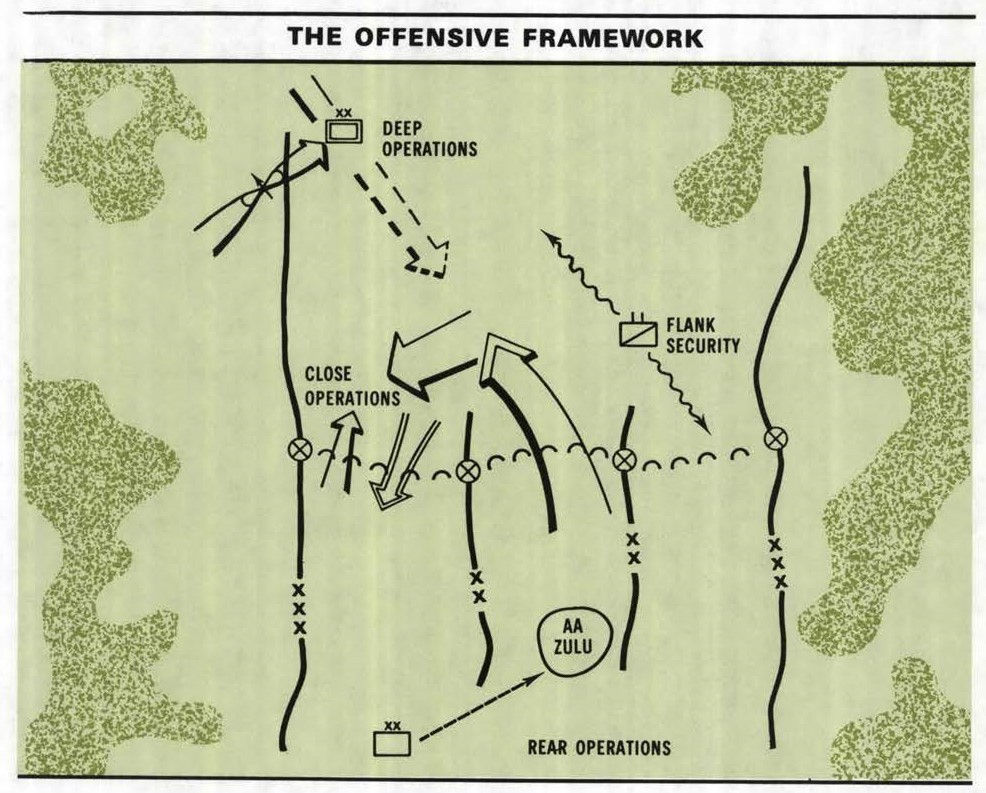
A series of U.S. Army Training and Doctrine Command commanding generals —Gen. Donn A. Starry (1977-1981), Gen. Glenn K. Otis (1981-1983), and Gen. William R. Richardson (1983-1986)—led the effort to revise the 1976 FM 100-5 document, culminating in two new Operations manuals that appeared in 1982 and 1986 respectively. Offensive Framework, shown, is from FM 100–5 (1986), Chapter 6, page 107.
VIEW ORIGINAL
U.S. Army Training and Doctrine Command’s 50th anniversary is July 1, 2023. In celebration, the TRADOC Communication Directorate in collaboration with the TRADOC Military History and Heritage Office, is sharing an article series highlighting key moments in TRADOC’s history to include the evolution of training, AirLand Battle, and gender integration.
JOINT BASE LANGLEY-EUSTIS, Va. – In 1976, TRADOC distributed 176,000 copies of the new Field Manual 100—5 Operations. This massive publication and dissemination effort marked but one of Gen. William E. DePuy’s, TRADOC’s first commanding general, purposes for the manual—to drive rapid change throughout an Army confronting an upgraded Soviet threat in Europe and contending with the aftermath of the long Vietnam War. Fresh doctrine, Depuy reasoned, would serve as a guidon for the Army, shaping everything it did, from training and education, to developing leaders and new equipment. Another no less significant purpose was to provide Soldiers with clear and practical guidance on how to fight and win on the modern battlefield against a peer opponent.
However, significant criticisms of Depuy’s brainchild emerged almost as soon as the last manual left the presses. First, many assessed that it prioritized defensive operations; the chapter on defense was indeed more robust than the one tackling the offense. Consequently, the term Active Defense quickly emerged as a shorthand reference for the manual. Second, the manual stressed the science of the application of modern firepower and force ratios, ignoring, some argued, the fundamental human element in warfare. Third, others contended the doctrine focused too narrowly on the Western European battlefield to the detriment of other forms of conflict across the spectrum of war. Finally, operational commanders worried that, in concentrating on tactical combat at the forward edge of the battle area, the manual neglected a key element of Soviet doctrine—that of echeloning forces in depth to maintain the momentum of any attack. This emphasis might commit U.S. Army ground forces to an attritional fight they could not win. Whatever their specific objections, all critics agreed with Depuy that future success started with 100—5, the Army’s capstone field manual, and that 100—5 should direct the force in all that it did.
A series of TRADOC commanders—Gen. Donn A. Starry (1977-1981), Gen. Glenn K. Otis (1981-1983), and Gen. William R. Richardson (1983-1986)—took up the challenge and led the effort to revise the 1976 document, culminating in two new Operations manuals that appeared in 1982 and 1986 respectively. Their sustained, consistent, and collective efforts saw not just revised doctrine, but the development of training and the fielding of equipment to make the doctrine work in practice.

Gen. Donn A Starry, U.S. Army Training and Doctrine Command commanding general from 1977-1981.
VIEW ORIGINAL
Taken together, the 1982 and 1986 editions of FM 100—5 addressed the perceived weaknesses of the earlier manual. For example, they introduced a concept, dubbed AirLand Battle, that dealt with the problem of Soviet offensive doctrine by emphasizing attacking throughout the depth of the battlespace through synchronized effort across the joint force. While the Army primarily managed the frontline fight, the Air Force (mainly) as well as Army attack aviation and long-range fires would attrite and disrupt second echelon Soviet forces. Furthermore, the new doctrine highlighted the value of maneuver and aggressive action with both local and deep counterattacks serving to shock adversaries and enhance the morale of Soldiers, who would now hit back as well as defend.
Although thankfully never tested in Western Europe, the TRADOC-led effort to transform Army doctrine and the force in tandem with it contributed directly to success in the Gulf War of 1990-1991. Echoes may also be heard today in the Army’s current multidomain operations concept.