


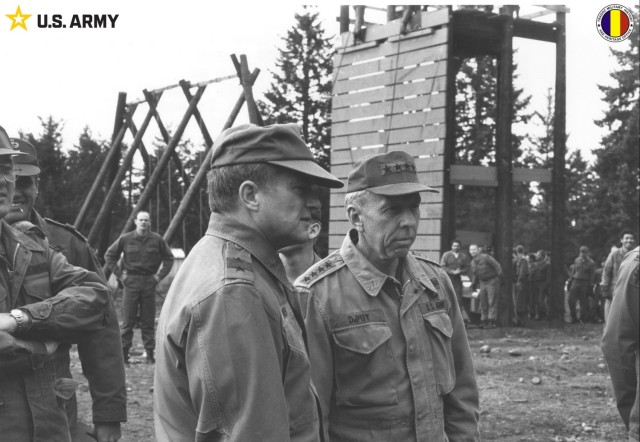
GEN William E. DePuy, CG TRADOC, with MG Volney F. Warner, ADCS for Operations, FORSCOM.
VIEW ORIGINAL

M551 Sheridan light tanks cross the desert during an Opposing Forces exercise at the National Training Center. The tanks have visual modifications designed to make them resemble Soviet armor, 1986.
VIEW ORIGINAL
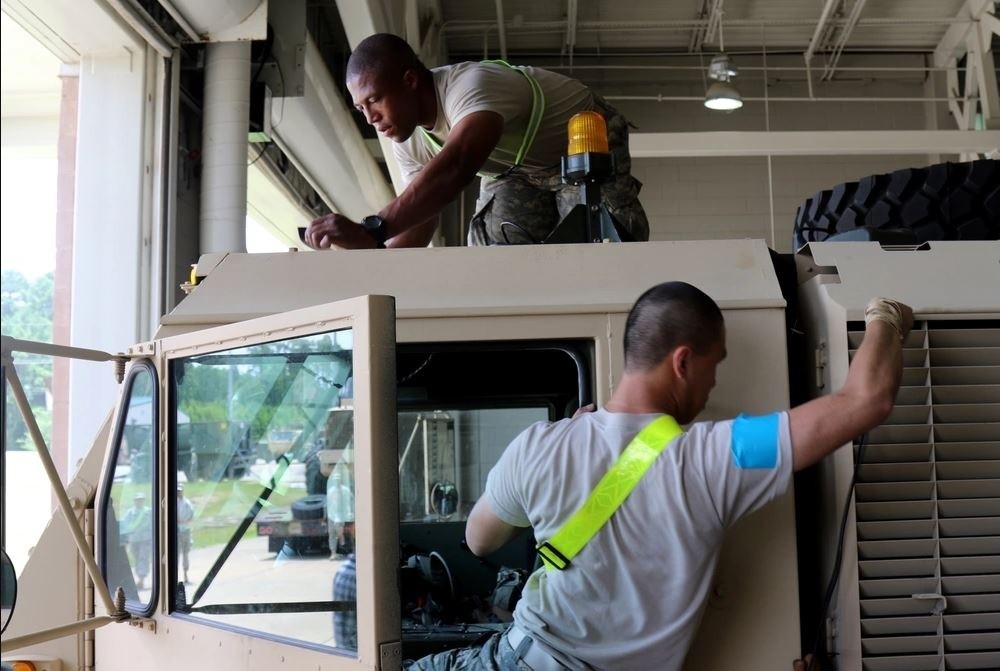
PFC Charles Liu, from the New York Army National Guard’s 1st Battalion, 69th Infantry Battalion, Headquarters and Headquarters Company, and SPC Jason Sneed, from Co. D, 1-69th Infantry, attach sensors for the Multiple Integrated Laser Engagement System to an armored tactical vehicle at the Joint Readiness Training Center, 2016.
VIEW ORIGINAL
Training is the cornerstone of the Army’s ability to fight and win. Training develops cohesive, fit, and disciplined teams and instills how the Army expects to fight.
When the US Army Training and Doctrine Command was established on 1 July 1973, the Army still followed the Army Training Plan, which originated in World War I. By design, TRADOC’s establishment initiated fundamental reform in how the Army approached training.
While many of the changes were incremental, the combined result was a training revolution. The architects of the first phase of this revolution were GEN William E. DePuy, the first TRADOC commander, and his Deputy Chief of Staff for Training, MG Paul F. Gorman.
With the establishment of the all-volunteer Army in 1973, GEN DePuy and MG Gorman realized that the ATP model of training a massive pool of conscripts over an extended period was no longer effective. Additionally, the increased lethality and enhanced range of the weapons used in the 1973 Arab–Israeli War brought home to DePuy and Gorman the imperative for well-trained crews and tactical commanders.
The Systems Approach to Training was the vehicle for change. Whereas the ATP prescribed the hours for each training task, it did not set standards of performance. The SAT required Soldiers to perform to established standards, as measured by Skill Qualification Tests. To complement the Officer Education System, DePuy and Gorman also established progressive and sequential training for the Noncommissioned Officer Education System.
TRADOC also revolutionized training in the field. In 1976, MG Gorman developed the concept for a National Training Center, where heavy armored and mechanized infantry units would train in live-fire exercises to support unit readiness, and doctrine and combat development. In January 1982, the NTC at Fort Irwin hosted its first force-on-force maneuvers.
The Army judged NTC a stunning success, which led to the establishment of the Joint Readiness Training Center for the training of light forces at Fort Chaffee, AR, and later at Fort Polk/Johnson, LA.
DePuy and Gorman also introduced training simulators to reduce the subjectivity of umpires and to increase realism, such as the Squad Combat Operations Exercise, Simulated SCOPES, and then advanced from telescopes to lasers with the Multiple Integrated Laser Engagement System.
The Simulation Network linked over 200 simulators, which allowed units to participate in simulations without leaving home station. The family of simulations allowed for training from platoon level to echelons above corps.
In May 1987, the training revolution culminated with the publication of a long-range plan: Army Training 1997. It integrated Reserve Component training into a Total Army program and knitted training and combat developments together under the Concepts-Based Requirements System.
From 1988 to 1990, TRADOC published its capstone training philosophy in a trilogy of “train, fight, lead” manuals: FM 25-100, Training the Force; FM 100-5, Operations; and FM 22-100, Military Leadership for commanders above battalion level. The publication of FM 25-101, Battle Focused Training, guided commanders at the battalion and company echelons.
TRADOC’s training revolution provided tough, realistic combined arms and services training aligned with Air Land Battle doctrine for units from squad through corps levels. In concert with the Big Five weapon systems and new doctrine, TRADOC’s training achievements were instrumental to victory during Operation Desert Storm.