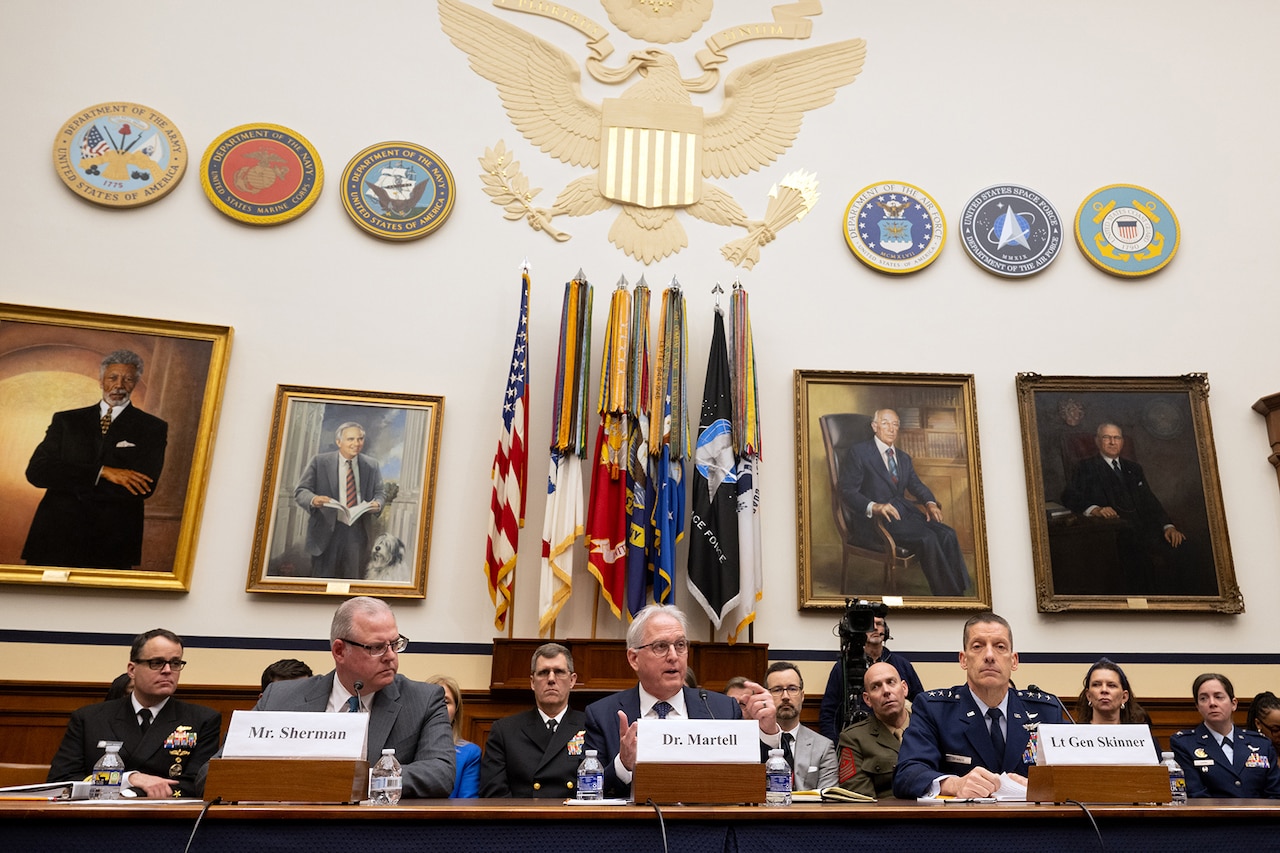
The Pentagon’s senior technology officials provided an update to Congress today on the Defense Department’s steps to ensure warfighters maintain the information and technology edge into the future.
John Sherman, DOD’s chief information officer, Craig Martell, DOD’s chief digital and artificial intelligence officer, and Air Force Lt. Gen. Robert J. Skinner, director of the Defense Information Systems Agency, underscored the department’s focus on providing the joint force with the information and tools required to meet current and emerging warfighting demands.
“It is critical more than ever that we provide DOD personnel with secure and resilient software when and where they need it,” Sherman testified before the House Armed Services’ Cyber, Information Technologies and Innovation Subcommittee.
“We recognize the urgency of this issue and are working hard to ensure we are successful,” he said.
Sherman said cyberthreats continue to emerge, as seen across Asia and Europe, and network protection across DOD and defense industry networks is paramount.
To address the threat, he said DOD has remained “laser focused” on implementing a zero trust cybersecurity framework.
Once implemented, the zero trust framework will move the DOD beyond traditional network security methods with capabilities designed to reduce exposure to cyberattacks, enable risk management and data sharing, and quickly contain and remediate adversary activities.
Sherman said the department is also making progress on initiatives to modernize information technology with a focus on cloud computing and software.
“When I testified last year, the department was just beginning the enterprise cloud journey and I’m happy to report significant and successful progress,” he said.
He said that the Defense Information Services Agency, or DISA, has awarded more than 47 task orders aligned to the department’s Joint Warfighter Cloud Capability, or JWCC, contract and has 50 more in the pipeline.
“We also published DOD guidance to streamline cloud contracting and reduce contract sprawl across the department,” Sherman said.
The JWCC contract was awarded in 2022 to ensure warfighters can access the DOD’s cloud infrastructure throughout the globe.
Skinner noted that, in addition to the progress highlighted by Sherman, DISA has also deployed an initial overseas cloud capability in support of U.S. Indo-Pacific Command.
He said DISA also recently piloted an initiative to deploy hybrid cloud capabilities to remote locations around the world.
“[I]t is critical that we ensure that DOD personnel have secure and resilient software regardless of where they are located,” Skinner said.
Martell said the Chief Digital and Artificial Intelligence Office, or CDAO, is accelerating the adoption of data analytics and AI across the department “so that the DOD can make better decisions faster from the boardroom to the battlefield.”
In recent months, the CDAO has taken significant steps to realize this vision.
In November, DOD released its strategy to accelerate the adoption of advanced artificial intelligence capabilities to ensure U.S. warfighters maintain decision superiority on the battlefield for years to come.
The strategy prescribes an agile approach to AI development and application, emphasizing speed of delivery and adoption at scale.
The blueprint also trains the focus of the department on several data, analytics and AI-related goals, ranging from improving foundational data management within the department to investing in interoperable infrastructure.
Taken together, these goals will support the “DOD AI hierarchy of needs,” which the AI adoption strategy defines as quality data, governance, insightful analytics and metrics, assurance and responsible AI.
“This hierarchy of needs, combined with our agile approach, is how we’re going to drive this sustainable change through a virtuous cycle,” Martell said.
He said this approach has led to success when applied to the development of DOD’s Combined Joint All-Domain Command and Control, or CJADC2, capability.
CJADC2 is the department’s approach to developing both material and nonmaterial solutions to deliver information and decision advantage to commanders.
The department aims to apply the CJADC2 approach across all warfighting domains to give warfighters the edge in deterring and, as necessary, defeating adversaries anywhere around the globe.
Last month, Deputy Defense Secretary Kathleen Hicks announced that the department has delivered its initial iteration of CJADC2, noting CDAO’s critical role in getting it across the finish line.
In his testimony, Martell said that success was a result of close integration between developers and warfighters and quickly iterating solutions.
“We deliver by learning by doing, shipping fast and iterating quickly with warfighters and … developers sitting side by side” he said.