


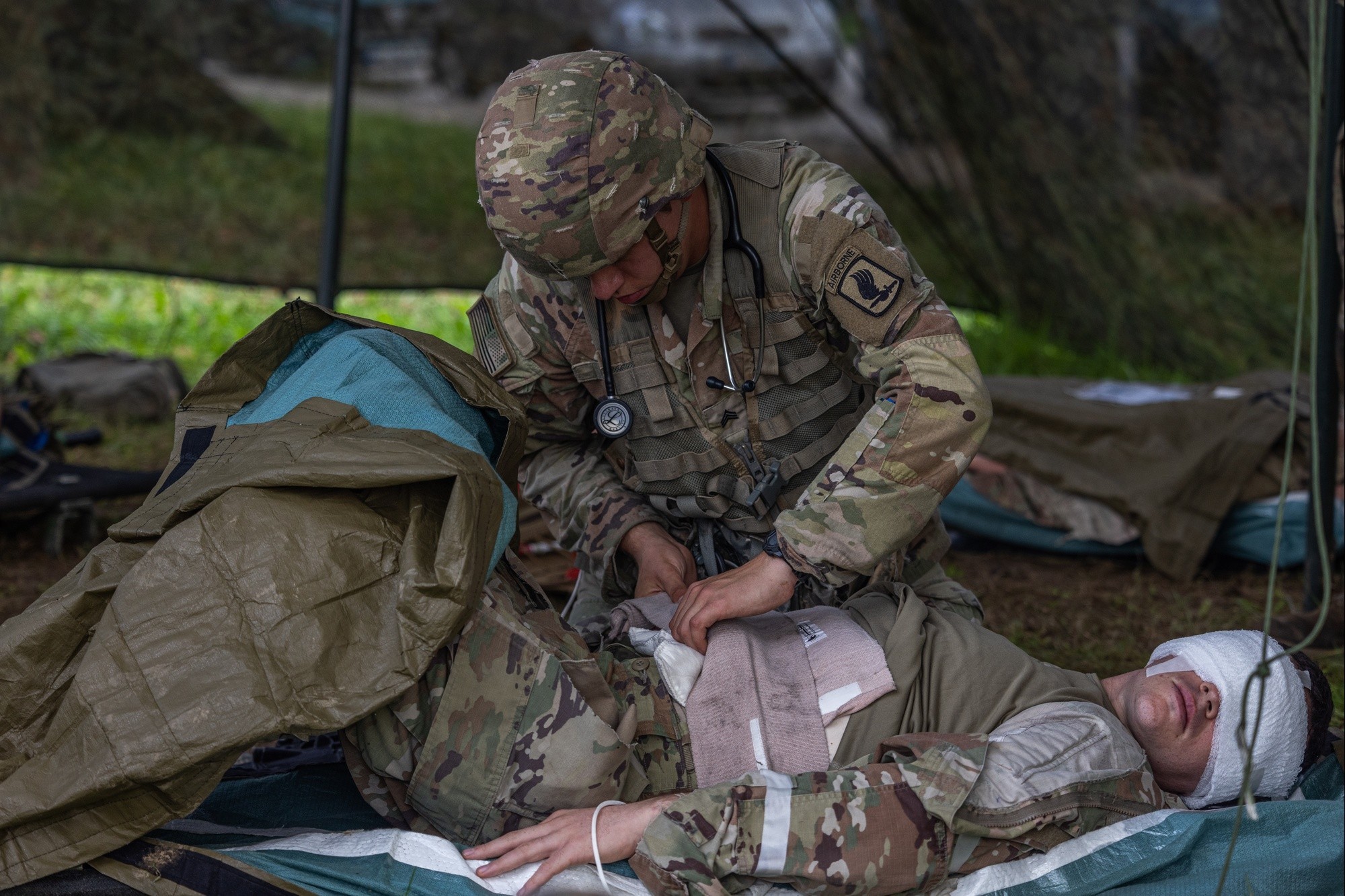
U.S. Army Spc. Zachary C. Wathen, combat medic specialist, 1st Battalion, 503rd Infantry Regiment, 173rd Airborne Brigade, performs care under fire during the tactical combat casualty care lane for the Expert Soldier, Expert Infantry, and Expert Field Medic Badge (E3B) at Caserma Del Din, Vicenza, Oct. 28, 2024. This year’s E3B is hosted by the 173rd Airborne Brigade and includes Soldiers from across Europe, including partners and allies from Croatia, Italy, the Netherlands, Slovenia and Spain. E3B creates experts at all levels, across all organizations, increasing readiness and lethality of Soldiers, teams, squads and platoons. These events are a key enabler to molding the force into professionals, while stressing commitment to every Soldier’s individual development. (U.S. Army photo by Spc. Ivan Hernandez)
VIEW ORIGINAL
VICENZA, Italy – Over 1,000 Soldiers from U.S. Army units across Europe, including 173rd Airborne Brigade and U.S. Army Southern European Task Force, Africa (SETAF-AF), as well as foreign partner soldiers, gathered at Caserma Del Din to earn the much-coveted Expert Soldier, Infantryman and Field Medical Badges, also known as the ‘E3B.’
E3B is a grueling test with multiple graded tasks conducted over a one-week period. It is the combination of the Expert Infantryman Badge, Expert Field Medical Badge and Expert Soldier Badge. This year’s E3B is hosted by the 173rd Airborne Brigade and includes soldiers from across Europe, including partners and allies from Croatia, Italy, the Netherlands, Slovenia and Spain.
One of the most challenging lanes for E3B is the Expert Field Medical Badge’s (EFMB) tactical combat casualty care (TCCC) lane.
“The TCCC lane is the pinnacle of the EFMB,” said U.S. Army Sgt. 1st Class James D. Miller, combat medic specialist, 173rd Brigade Support Battalion, 173rd Airborne Brigade, and the noncommissioned officer in charge of the TCCC lane. “It shows your ability to treat the casualty, from point of injury to evacuation.”
U.S. Army Sgt. Benjamin S. Evans, combat medic specialist, 1st Squadron, 91st Cavalry Regiment (Airborne), 173rd Airborne Brigade, demonstrates tactical combat casualty care to Soldiers training for the upcoming for the Expert Soldier, Expert Infantry, and Expert Field Medic Badge (E3B) at Caserma Del Din, Vicenza, Oct. 28, 2024. This year’s E3B is hosted by the 173rd Airborne Brigade and includes Soldiers from across Europe, including partners and allies from Croatia, Italy, the Netherlands, Slovenia and Spain. E3B creates experts at all levels, across all organizations, increasing readiness and lethality of Soldiers, teams, squads and platoons. These events are a key enabler to molding the force into professionals, while stressing commitment to every Soldier’s individual development. (U.S. Army photo by Spc. Ivan Hernandez)
VIEW ORIGINAL
TCCC originated when a Naval Special Warfare biomedical research effort was launched after the realization that extremity hemorrhage, a leading cause of preventable death on the battlefield, was not being treated with a readily available and highly effective intervention: the tourniquet. After its implementation, TCCC has provided lifesaving capabilities to injured combatants by limiting further casualties and ensuring mission success on the battlefield.
“What we’re looking for is good medicine, ensuring what you’re doing is what needs to be done according to the book, but in a medical sense as well,” said Miller. “This lane in particular really demands perfection. You have someone’s life in your hands and any mishap can cost that life.”
For this lane, participants must be evaluated in their ability to treat multiple patients simultaneously, while providing lifesaving interventions and timely evacuation. During this evaluation candidates must perform all TCCC tasks to include treating a massive hemorrhage, airway management, respiration management, circulation management, circulation management, hypothermia management, a detailed physical exam, and completing a TCCC card. All of this must be performed on all simulated casualties. Considered to be the hardest lane for EFMB, it demands a lot from candidates.
“I don’t think it’s an opinion,” said Miller. “If you look at it statistically, this lane is the one where candidates receive ‘NO-GOs’ the most.”
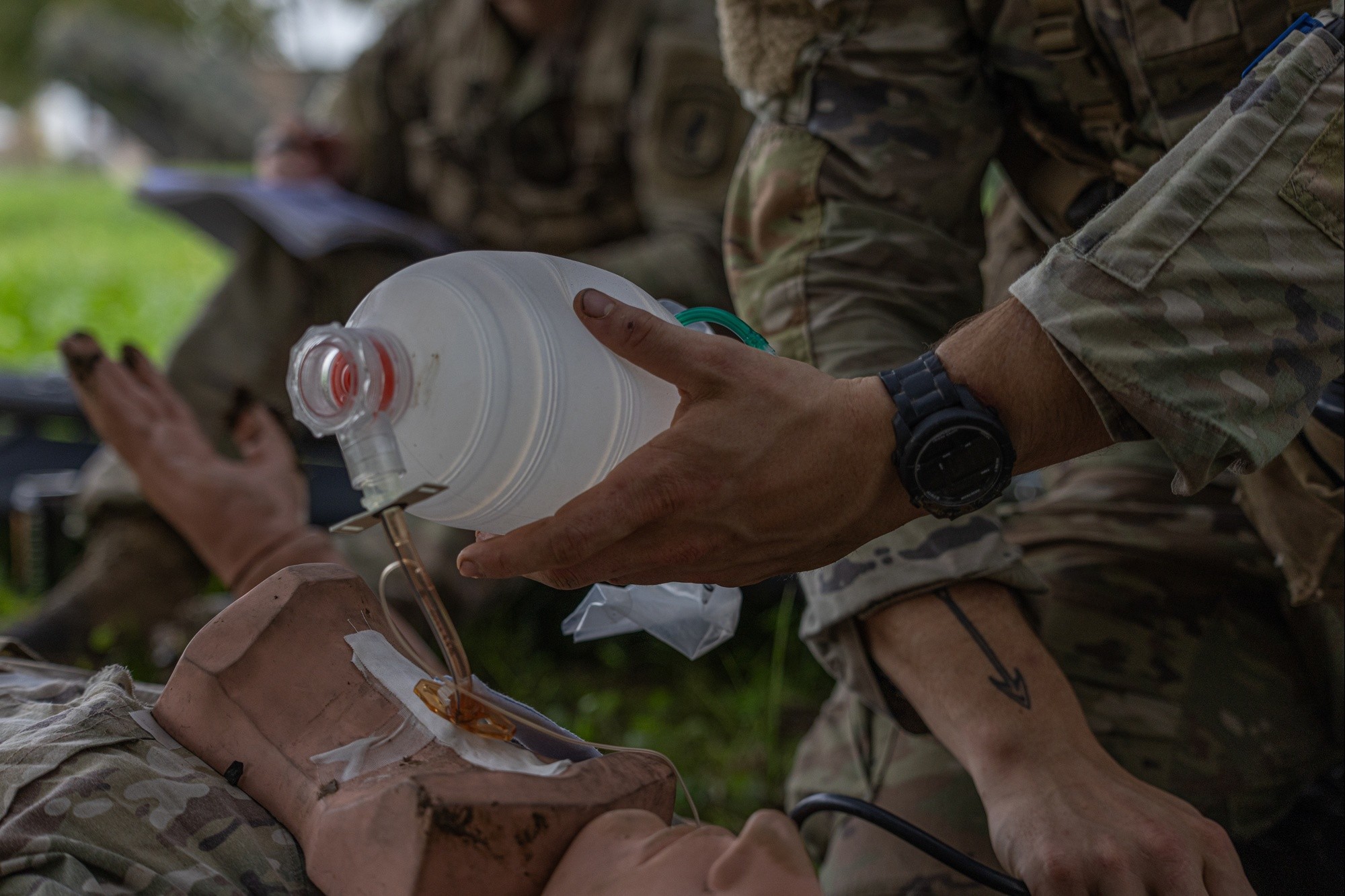
U.S. Army Spc. Zachary C. Wathen, combat medic specialist, 1st Battalion, 503rd Infantry Regiment, 173rd Airborne Brigade, performs tactical field care during the tactical combat casualty care lane for the Expert Soldier, Expert Infantry, and Expert Field Medic Badge (E3B) at Caserma Del Din, Vicenza, Oct. 28, 2024. This year’s E3B is hosted by the 173rd Airborne Brigade and includes Soldiers from across Europe, including partners and allies from Croatia, Italy, the Netherlands, Slovenia and Spain. E3B creates experts at all levels, across all organizations, increasing readiness and lethality of Soldiers, teams, squads and platoons. These events are a key enabler to molding the force into professionals, while stressing commitment to every Soldier’s individual development. (U.S. Army photo by Spc. Ivan Hernandez)
VIEW ORIGINAL
Candidates must perform TCCC on three casualties, attain ‘GOs’ on all nine critical tasks and receive at least 10 out of 12 ‘GOs’ on the non-critical tasks. If they do not perform all of this under one hour and 45 minutes, they receive a ‘NO-GO’ for the entire lane.
U.S. Army 1st Lt. John A. Zarella, a health service administrator assigned to the 2nd Cavalry Regiment, is competing for his EFMB and discussed the stress of the TCCC lane.
“Staying focused is the most challenging part of this lane,” said Zarella. “You can memorize everything for this event but once you’re doing it and time goes by, you start to forget certain steps.”
“The biggest thing is that the patients survive, by stopping the bleeding first, controlling the airway so that the patient can breathe,” said U.S. Army Sgt. William C. Weirough, combat medic specialist and one of the TCCC graders, assigned to 173rd Airborne Brigade’s Support Battalion. “You have to be on top of your game and be confident in your ability to treat all casualties in order of life-threatening injuries, but in a timely fashion as well.”
Weirough reflected on when he had to go through this lane to earn his own EFMB back in 2022.
“I was confident. I went with a mentality that I know this; this is my job, and this has to be a perfect lane,” he said. “You gotta think this is a real patient. If you get a ‘GO,’ well, you just saved a life; but if you get a ‘NO-GO,’ you lost a life”
Sgt. Daniel Pena, a combat medic assigned to the 2nd Cavalry Regiment, another grader for the EFMB lane, received his EFMB badge in 2023.
“The first time I did it, I actually failed,” said Pena. “On my second attempt, I actually passed. I was super excited and did my 12-mile ruck the next day as the final assessment.”
The TCCC lane truly shows the skill and craft of being in the U.S. Army medical field. It tests the fundamentals of TCCC and the candidates’ speed, but also their carefulness while treating three casualties.
“It is a good lane. It truly tests your skills as a medic,” said U.S. Army Sgt. Wendell B. Rightmire, a combat medic assigned to the 2nd Cavalry Regiment, and a competitor for the EFMB. “As long as you’re solid with your fundamentals on TCCC, all you need is to memorize the order of events.”
With the testing week beginning today—all the practice and lessons learned will be put to the test as this year’s candidates seek to earn the prestigious EFMB.
“If you’re an infantryman, engineer or cavalry scout, if you have a medic on your team and they have this badge on their chest, it says a lot,” said Miller. “They’re the small percentage that went out and got their badge to be the expert in their field.”
About E3B
This year’s E3B is hosted by the 173rd Airborne Brigade and includes Soldiers from across Europe, including partners and allies from Croatia, Italy, the Netherlands, Slovenia and Spain. E3B creates experts at all levels, across all organizations, increasing readiness and lethality of Soldiers, teams, squads and platoons, molding the force into professionals, while stressing commitment to every Soldier’s individual development.
Find more articles, video and photos from E3B Europe at: https://www.dvidshub.net/feature/ExpertBadgesEurope
About SETAF-AF
SETAF-AF provides U.S. Africa Command and U.S. Army Europe and Africa a dedicated headquarters to synchronize Army activities in Africa and scalable crisis-response options in Africa and Europe.
Follow SETAF-AF on:
Facebook, Twitter, Instagram, YouTube, LinkedIn & DVIDS
