


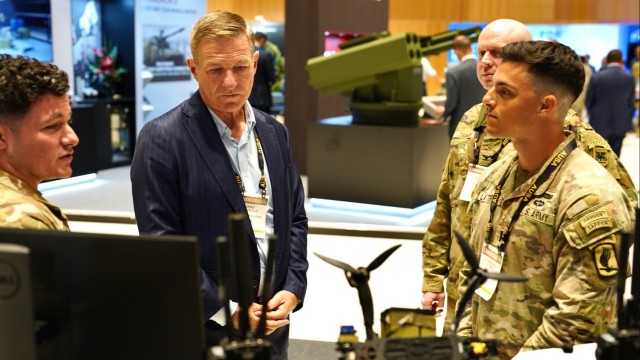
U.S. Army 1st Lt. Vincent Gasparri, bayonet innovation team director, 173rd Airborne, Brigade, Gen. (retired) James McConville, former U.S. Army chief of staff, and 1st Lt. Francesco La Torre, bayonet innovation robotics and autonomous systems director, 173rd Airborne Brigade, discuss lethality and readiness with U.S. Army Soldiers during LANDEURO 2025 in Wiesbaden, Germany, July 16, 2025. This discussion highlights the ongoing commitment to enhancing combat effectiveness and ensuring forces are prepared for complex operations across various domains. Such engagements at LANDEURO reinforce the strategic competition efforts and increase the readiness and lethality of U.S. Army forces to achieve U.S. Army Europe and Africa and U.S. Africa Command campaign objectives. (U.S. Army photo by Maj. Edward McBride)
VIEW ORIGINAL
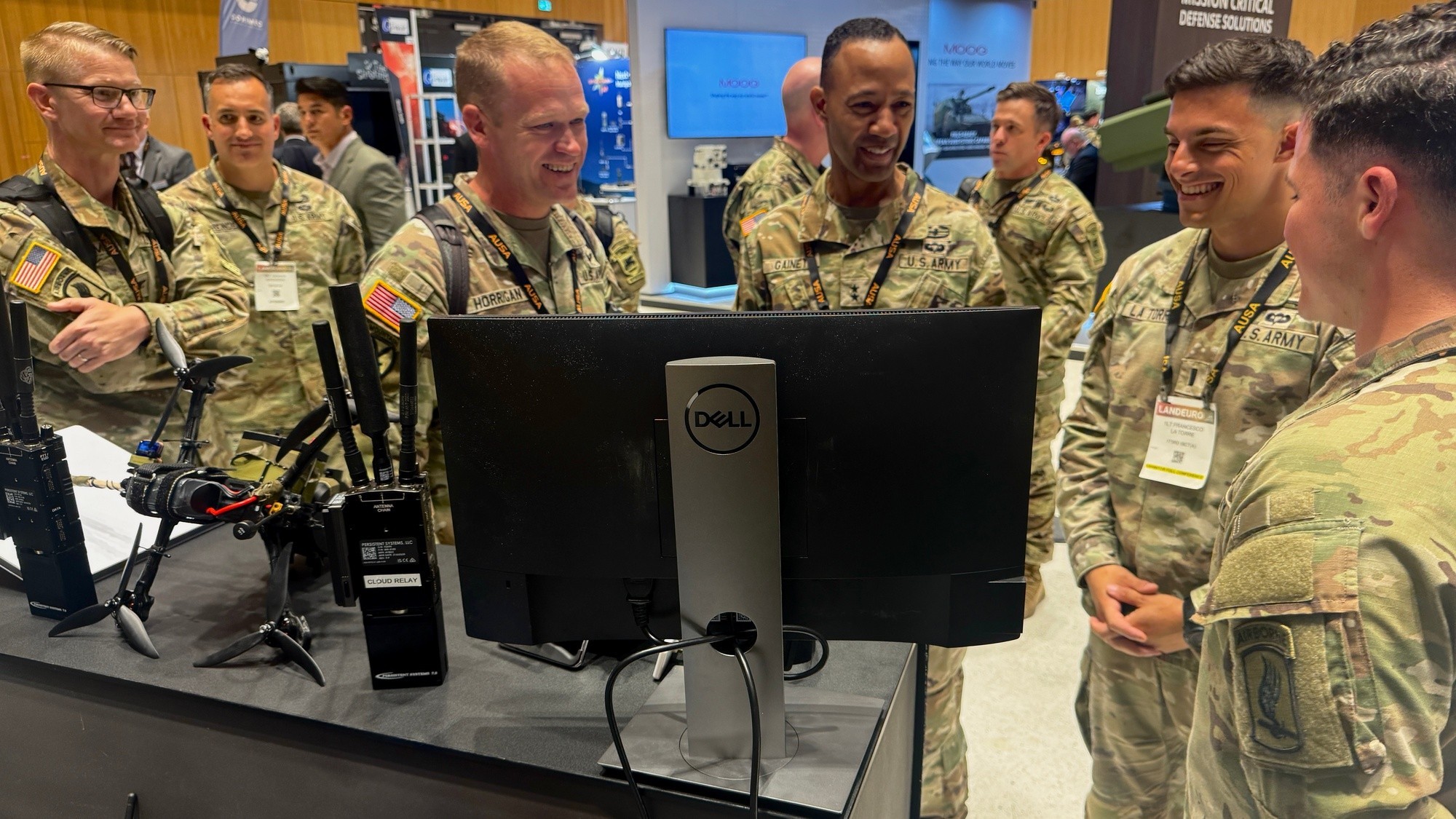
1st Lt. Francesco La Torre, bayonet innovation robotics and autonomous systems director, 173rd Airborne Brigade, watches a video with Maj. Gen. Andrew Gainey, commanding general, U.S. Army Southern European Task Force, Africa (SETAF-AF), and Col. Scott Horrigan, chief of staff, U.S. Army Southern European Task Force, Africa (SETAF-AF), highlighting the use of their explosive unmanned aerial system during a recent live-fire training during LANDEURO 2025 in Wiesbaden, Germany, July 16, 2025. This interaction underscores SETAF-AF’s commitment to integrating advanced technologies and innovative solutions into military operations, enhancing force lethality and readiness. Showcasing these capabilities at LANDEURO reinforces partnerships and contributes to achieving U.S. Army Europe and Africa and U.S. Africa Command campaign objectives. (U.S. Army photo by Maj. Edward McBride)
VIEW ORIGINAL
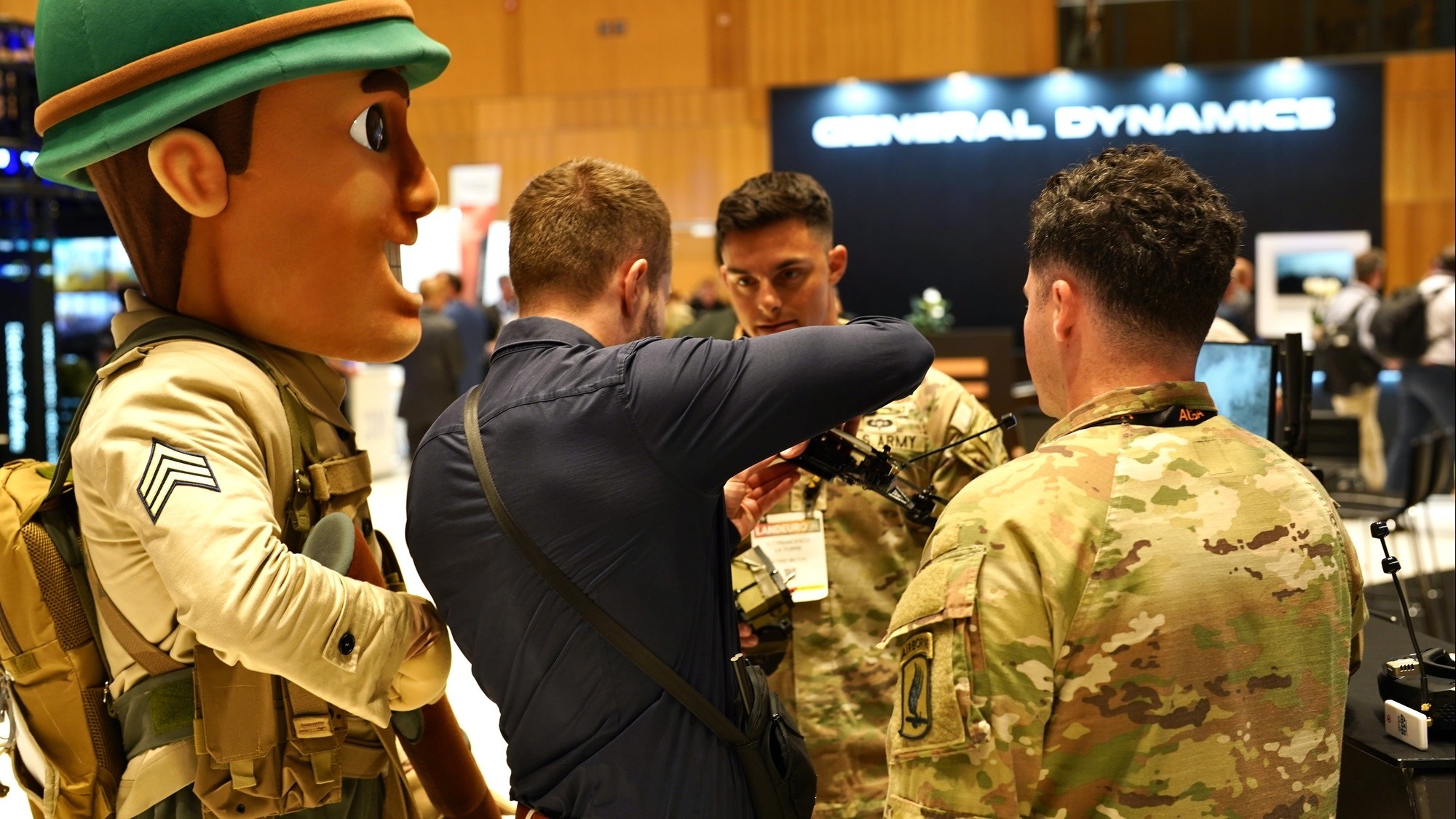
U.S. Army 1st Lt. Vincent Gasparri, bayonet innovation team director, 173rd Airborne Brigade, right, and 1st Lt. Francesco La Torre, bayonet innovation robotics and autonomous systems director, 173rd Airborne Brigade, center, discuss robotics with Sgt. Hero, the Association of the United States Army’s (AUSA) mascot, and a member of the AUSA mascot team during LANDEURO 2025 in Wiesbaden, Germany, July 16, 2025. This interaction highlights the 173rd Airborne Brigade’s commitment to advancing military capabilities through robotic innovation. Engaging with AUSA and the public at events like LANDEURO demonstrates SETAF-AF’s dedication to developing future forces and strengthening partnerships, ultimately contributing to U.S. Army Europe and Africa and U.S. Africa Command campaign objectives. (U.S. Army photo by Maj. Edward McBride)
VIEW ORIGINAL

U.S. Army 1st Lt. Vincent Gasparri, bayonet innovation team director, 173rd Airborne Brigade, left, U.S. Army Col. Adontis Atkins, command, control, communications and computers director, U.S. Army Southern European Task Force, Africa (SETAF-AF), and 1st Lt. Francesco La Torre, bayonet innovation robotics and autonomous systems director, 173rd Airborne Brigade, discuss data transmission, signal transmission, and computational processing at the 173rd Airborne Brigade’s Bayonet Innovation Team small unmanned aerial system exhibit during LANDEURO 2025 in Wiesbaden, Germany, July 16, 2025. This discussion highlights the critical role of advanced technology in enhancing military operations and maintaining a decisive edge. Showcasing these capabilities aligns with SETAF-AF’s mission to increase lethality and readiness and contributes to achieving U.S. Army Europe and Africa and U.S. Africa Command campaign objectives. (U.S. Army photo by Maj. Edward McBride)
VIEW ORIGINAL

Ghana Armed Forces Maj. Gen. Lawrence Kwaku Gbetanu, chief of army staff, and U.S. Army Col. Mark Bush, commander, 173rd Airborne Brigade, discuss the Bayonet Innovation Team’s Association of the United States Army (AUSA) exhibit during LANDEURO 2025 in Wiesbaden, Germany, July 16, 2025. This engagement highlights the collaborative efforts between U.S. and Ghanaian forces to explore innovative military solutions. Such discussions at LANDEURO reinforce strategic partnerships, increase lethality and readiness, and contribute to achieving U.S. Army Europe and Africa and U.S. Africa Command campaign objectives. (U.S. Army photo by Maj. Edward McBride)
VIEW ORIGINAL

U.S. Army Gen. (retired) James McConville, former U.S. Army chief of staff, left, Maj. Gen. Andrew Gainey, commanding general, U.S. Army Southern European Task Force, Africa (SETAF-AF), and Command Sgt. Maj. Chad Harness, command sergeant major, U.S. Army Southern European Task Force, Africa (SETAF-AF), discuss the 173rd Airborne Brigade Bayonet Innovation Team’s small unmanned aerial systems exhibit during LANDEURO 2025 in Wiesbaden, Germany, July 16, 2025. This exchange highlights the continued importance of innovation in enhancing the readiness and lethality of U.S. Army forces. Engaging with leadership at events like LANDEURO supports SETAF-AF’s mission to enable strategic competition and achieve U.S. Army Europe and Africa and U.S. Africa Command campaign objectives. (U.S. Army photo by Maj. Edward McBride)
VIEW ORIGINAL
VICENZA, Italy – U.S. Soldiers assigned to the 173rd Airborne Brigade’s Bayonet Innovation Team (BIT), alongside counterparts from the Multi-Domain Command Europe (MDCE), showcased their innovation efforts during the inaugural LANDEURO Symposium and Exposition, July 16–17, in Wiesbaden, Germany.
The 173rd’s BIT joined MDCE’s innovation team to talk about their collaborative efforts to help drive bottom-up innovation. Both teams operate in-house drone labs to rapidly produce unmanned aerial systems, specifically tailored to mission requirements. This initiative strengthens autonomy and supports scalable innovation at the unit level, directly aligning with the Army Transformation Initiative.
These innovation teams supported each other’s establishment by exchanging knowledge and expertise on a regular basis. Together, these units consulted with roughly 100 external entities to date, on innovation.
“I’m proud to say that I walked around LANDEURO and knew a lot of the industry part or private industry teams very well,” said U.S. Army 1st Lt. Vincent Gasparri, director of the 173rd’s BIT.
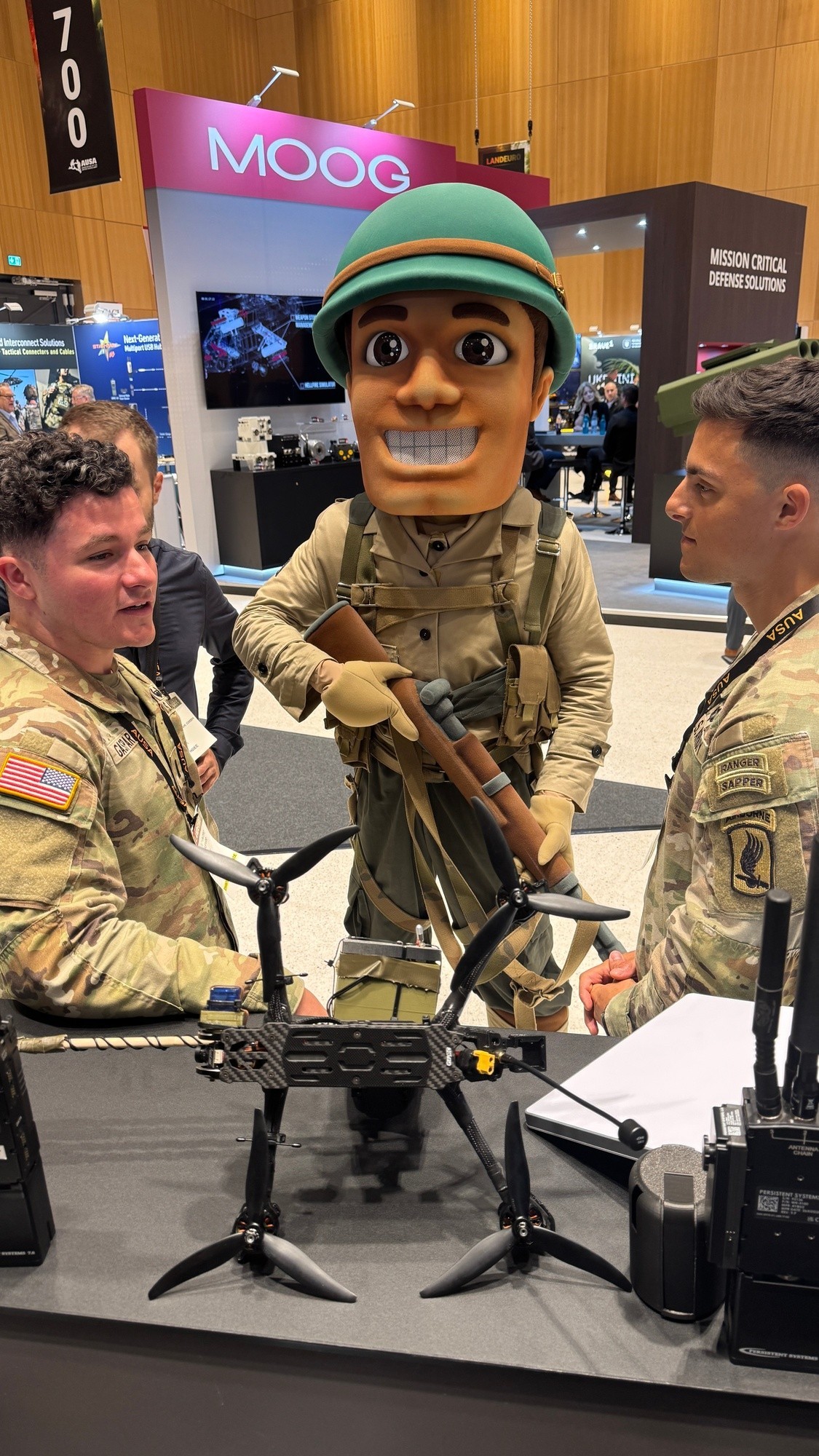
U.S. Army 1st Lt. Vincent Gasparri, bayonet innovation team director, 173rd Airborne Brigade, and 1st Lt. Francesco La Torre, bayonet innovation robotics and autonomous systems director, 173rd Airborne Brigade, speak with Sgt. Hero, the Association of the United States Army’s mascot, about their small unmanned aerial system’s capabilities during LANDEURO 2025 in Wiesbaden, Germany, July 17, 2025. This interaction highlights the 173rd Airborne Brigade’s commitment to integrating advanced technologies and fostering innovation to enhance Army readiness and lethality. Events like LANDEURO provide a crucial platform for sharing these advancements and strengthening partnerships, ultimately contributing to U.S. Army Europe and Africa and U.S. Africa Command campaign objectives. (U.S. Army photo by Maj. Edward McBride)
VIEW ORIGINAL
These working relationships with industry demonstrate the team’s commitment to advancing not only its own capabilities but also the Army’s broader innovation ecosystem.
The event allowed the 173rd’s BIT to strengthen growing partnerships with other innovation teams through face-to-face engagements and exchange technical knowledge.
Gasparri said the 2nd Multi-Domain Task Force and 56th Fires (MCDE) are strategically important capabilities in the European theater, noting their efforts are supported by technical experts from U.S. European Command and U.S. Army Europe and Africa. He further clarified that LANDEURO highlighted the importance of in-person collaboration, enabling alignment with MDCE on design sharing and strengthening the innovation ecosystem across tactical and strategic formations.
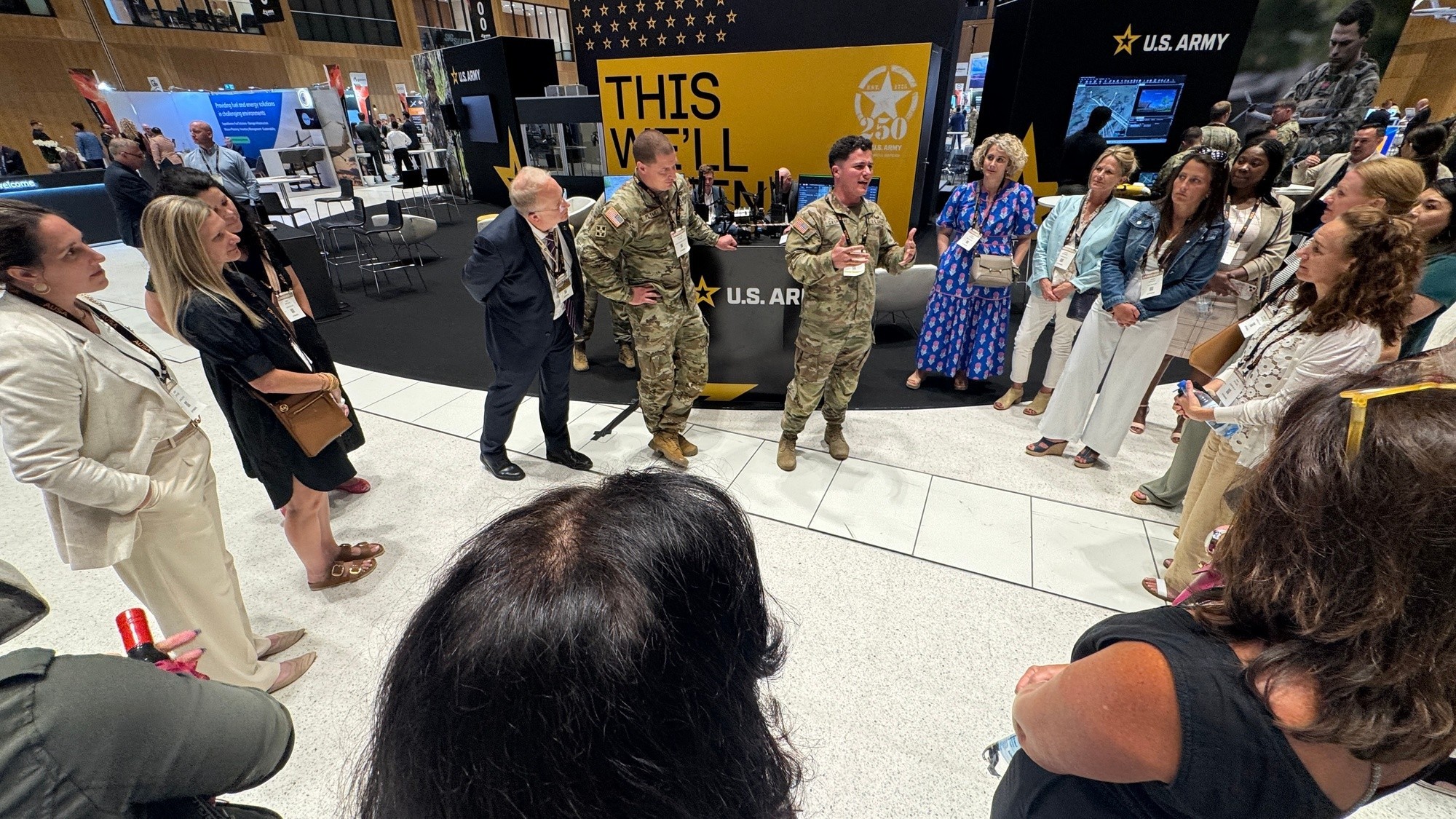
U.S. Army 1st Lt. Vincent Gasparri, bayonet innovation team director, 173rd Airborne Brigade, and 1st Lt. Francesco La Torre, bayonet innovation robotics and autonomous systems director, 173rd Airborne Brigade, discuss with a large group of LANDEURO attendees about the importance of science, technology, engineering, and mathematics degrees and how critical thinking has supported their efforts during LANDEURO 2025 in Wiesbaden, Germany, July 16, 2025. This engagement showcased how the 173rd Airborne Brigade leverages innovative thinking and technological advancements to enhance readiness and lethality. By fostering partnerships and sharing insights on the application of STEM principles, the 173rd Airborne Brigade contributes to achieving U.S. Army Europe and Africa and U.S. Africa Command campaign objectives. (U.S. Army photo by Maj. Edward Mcbride)
VIEW ORIGINAL
Though operating at different echelons, both units are solving similar challenges through internally developed drone systems. The 173rd focuses on purpose-built, attritable first-person view (FPV) drones tailored to the unit’s rapid-deployment, tactical mission sets, while the MCDE builds intelligence, surveillance and reconnaissance-capable systems that enhance strategic long-range fires. The units continue to share computer-aided design files and parts lists to cross-build platforms, accelerating innovation across the Army.
The 173rd’s BIT demonstrates bottom-up innovation. Its efforts include integrating FPV drones into live-fire training and certifying non-tactical unmanned aerial system operators who construct their own drones. They recently conducted the 173rd Airborne Brigade’s first FPV drone live-fire on autonomous moving targets during Swift Response 2025 at Pabrade Training Area, Lithuania, May 18, 2025.
Collaboration is fundamental to their innovative efforts. Ahead of LANDEURO, the 173rd’s BIT worked alongside 2nd Cavalry Regiment’s (2CR) innovation team by regularly sharing code and best practices. U.S. Army Capt. Ronan Sefton, an intelligence officer previously assigned to 2CR, emphasized this multi-unit approach. During an interview at Balli Airfield in Vilseck, Germany, he explained how 2CR’s drone innovation lab was created and how it is transforming the way units develop and share drone capabilities.
“What’s great about this space is that 2CR can be here and the 173rd’s here, and we’re constantly working together to improve each other’s designs,” said Sefton.

U.S. Army 1st Lt. Vincent Gasparri, bayonet innovation team director, 173rd Airborne Brigade, and 1st Lt. Francesco La Torre, bayonet innovation robotics and autonomous systems director, 173rd Airborne Brigade, highlight the 173rd Airborne Brigade’s Bayonet Innovation Team’s capabilities with Ghana Armed Forces Maj. Gen. Lawrence Kwaku Gbetanu, land force commander, during LANDEURO 2025 in Wiesbaden, Germany, July 16, 2025. This demonstration showcases how the 173rd Airborne Brigade is integrating cutting-edge technology to enhance its readiness and lethality. Such engagements with international partners at LANDEURO reinforce U.S. Army Southern European Task Force, Africa (SETAF-AF)’s commitment to enabling strategic competition and achieving U.S. Army Europe and Africa and U.S. Africa Command campaign objectives. (U.S. Army photo by Maj. Edward McBride)
VIEW ORIGINAL
The 2CR’s small unmanned aerial systems program operates a multi-patch drone innovation lab, providing a shared environment for the 173rd and other units to exchange designs, assistance and lessons learned.
“One of the kind of great parts about how it’s multi-patch is we don’t get into the stovepipe of where 2CR is only interacting with 2CR, and we’re not really improving each other,” Sefton explained.
This lab, equipped with soldering stations and 3D printers, produced 30 purpose-built drone systems between February and April 2025, showcasing its rapid prototyping capacity.
“The whole concept is we’re designing them and constantly adapting them, and there isn’t this long research or sort of testing timeline that has to occur,” Sefton added.
LANDEURO provided these innovative teams with a forum for emphasizing cooperation, innovation and readiness. Their shared experiences and ongoing collaboration underscore the U.S. Army’s commitment to readiness and lethality in a rapidly evolving security landscape.
About SETAF-AF
SETAF-AF) prepares Army forces, executes crisis response, enables strategic competition and strengthens partners to achieve U.S. Army Europe and Africa and U.S. Africa Command campaign objectives.
About 173rd Airborne Brigade
The 173rd Airborne Brigade is the U.S. Army’s Contingency Response Force in Europe, providing rapidly deployable forces to the United States European, African, and Central Command areas of responsibility. Forward stationed in Italy and Germany, the brigade routinely trains alongside NATO allies and partners to enhance readiness and lethality.
Follow SETAF-AF on: Facebook, Twitter, Instagram, YouTube, LinkedIn & DVIDS
