During World War II, Dr. Willem Kolff revolutionized medical science by creating the first ‘artificial kidney’ from everyday items like juice cans, sausage casings and parts of an old washing machine. This wartime innovation laid the foundation for modern dialysis, a lifesaving treatment for kidney failure patients.
Today, VA is making improvements to dialysis that could be just as revolutionary.
“Our population of Veterans with chronic and end-stage renal disease is growing all the time,” said Rita Tassinari, Phoenix VA specialty procedures nurse manager. “Dialysis is the lifesaving and life-changing procedure keeping those patients alive.”
Dialysis patients often undergo treatment three times a week for three to four hours each session, sometimes for years while awaiting a transplant or other outcomes. With so much at stake, preventing complications is crucial.
Addressing a critical safety concern
In 2008, VA’s National Center for Patient Safety (NCPS) analyzed clinical reports of bleeding incidents and found that bloodline disconnections were a leading cause of dialysis leaks. They issued a patient safety advisory and provided recommendations for the early detection and prevention of bloodline disconnections.
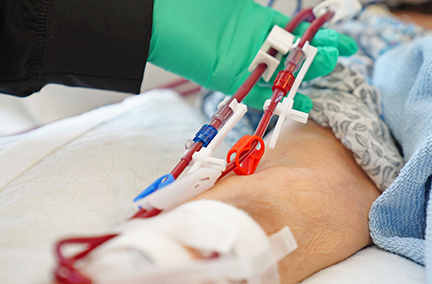
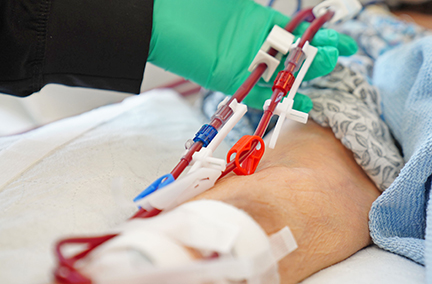
In 2010, a patient alert was also issued reinforcing the need to keep access sites visible and portraying the protective value of using Fresenius HemaClips where Fresenius bloodlines are employed.
“We focus on evidence-based solutions to address safety challenges specific to the Veteran population,” explained Rabeh Hijazi, biomedical engineer.
These leaks can be dangerous, especially considering the hemodialysis pump runs 400-500 milliliters per minute.
To mitigate this risk, NCPS recommended facilities assess the fit of HemaClips with their existing catheters. “It is a plastic piece that acts as a lower lock,” said Boby Jose, president of the Phoenix chapter of the American Nephrology Nurses Association.
Jose’s advocacy for the HemaClip stems from a tragic experience earlier in his career where a patient lost their life due to the absence of such a safety measure. “We’ve never had that happen here, but it is the kind of event that if it happens, it is almost always catastrophic.”
Simulation: A key to safety innovation
Despite the HemaClip’s potential, clinicians faced a hurdle. The manufacturer states it is intended only for Fresenius blood tubing. To address this limitation, NCPS collaborated with frontline clinicians and the Simulation Learning, Evaluation, Assessment, and Research Network (SimLEARN) to conduct a thorough evaluation as well as the application of the product on the different tubing.
“Simulation provided us opportunities for real-time feedback and debriefing. This process helped us identify areas for improvement, reinforce effective practices and address any gaps in knowledge or skills,” Hijazi added.
The team developed a simulation scenario to test the Fresenius HemaClips on four different manufacturers’ tubing. “We tried countless ways to make it fail and it did not fail,” Tassinari said. “By replicating realistic clinical scenarios, the simulation helped staff recognize and understand potential safety hazards and error-prone situations associated with Fresenius HemaClips and bloodlines. There is a lot of value in simulation. It allows you the opportunity to try things out before you try them on a live patient. It gives you permission to fail. It also allows you to try things that maybe you wouldn’t necessarily be able to try with a patient.”
Based on these simulation results, NCPS provided technical information to approximately 250 VA nephrologists to make informed decisions, impacting care for more than 6,000 outpatient Veterans and numerous inpatients requiring acute treatment.
A personal connection to service
For Tassinari, this work is of particular significance. “My father was a World War II Veteran who died when I was younger. Working here is the closest I have felt to my dad in such a long time.”
To learn more about how simulation supports frontline staff and improves patient care, visit SimLEARN and subscribe to its newsletter.
To learn more about the National Center for Patient Safety, visit the VHA National Center for Patient Safety.
Disclaimer of endorsement
Reference herein to any specific commercial products, process, or service by trade name, trademark, manufacturer, or otherwise, does not necessarily constitute or imply its endorsement, recommendation, or favoring by the United States Government.